
The Hidden Cost of “Covered” Care: Why Paying Directly for Medical Care Can Save You Money, Time, and Pain
You have pain→You book an appointment at a clinic “covered” by your insurance plan→Day of the appointment, You pay your copay→You see the doctor or NP or PA→You are prescribed medication, get a PT script, having imaging performed or ordered, and/or get an injection……..
Three to six months later, you open your mailbox to find a “surprise” bill for hundreds—or even thousands—of dollars for services your insurance retroactively decided not to cover.
I have seen patients exhausted by this cycle every day. In fact, I’ve experienced this myself!
That is exactly why I operate on a direct-pay (cash) model. While paying out-of-pocket for medical care might sound counterintuitive when you pay monthly insurance premiums, the reality is that a direct-pay model is vastly more efficient, transparent, and cost-effective in the long run.
Here is why skipping the insurance line may be the best investment in your health!
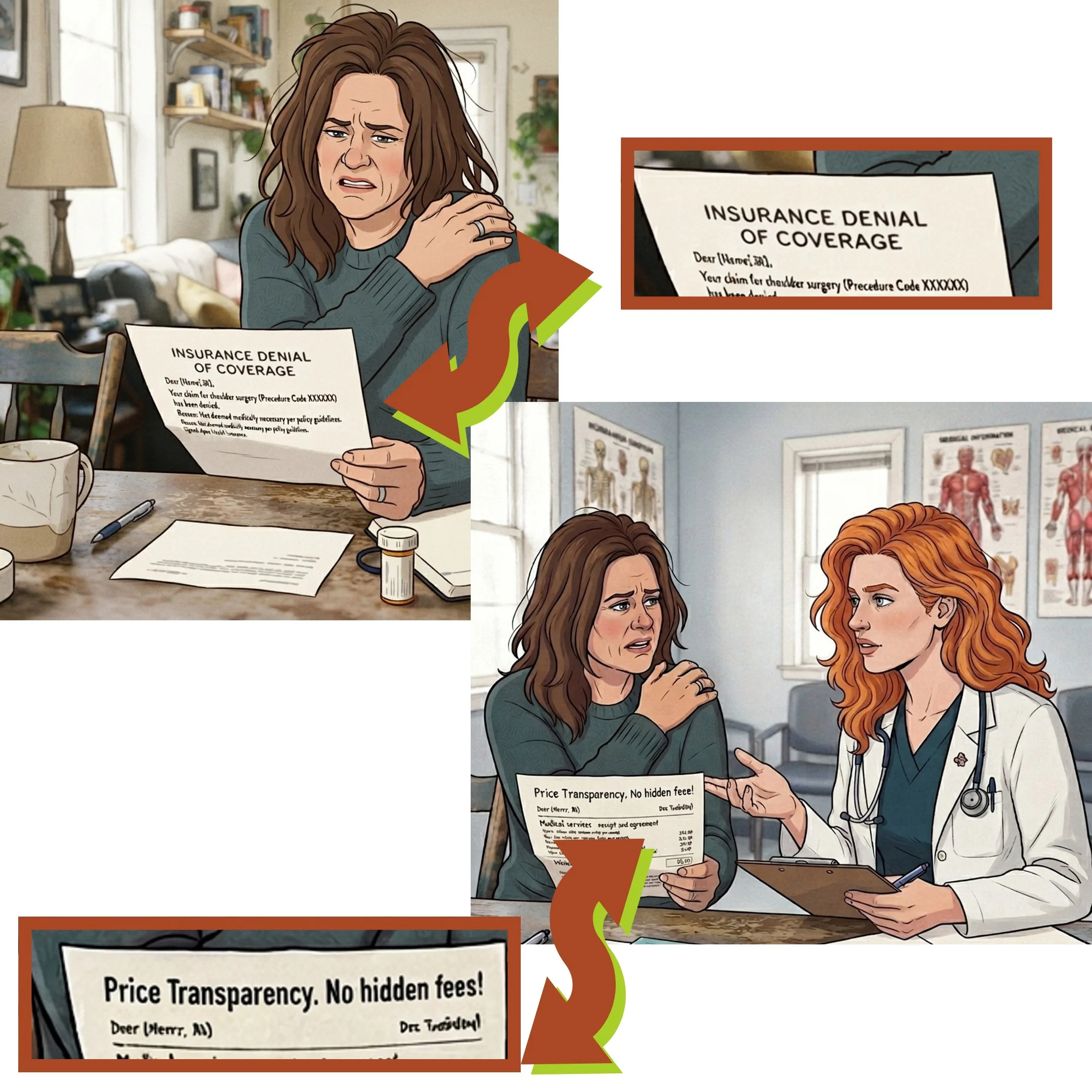
Description: Woman with left shoulder pain is holding letter that says "Insurance Denial". 2nd picture shows woman in pain talking to female doctor with a letter that says, "Price Transparency. No hidden fees!"
1. No "Phantom Bills" Months Later
The insurance model is notorious for its lack of price transparency. You go to a clinic, hand over your card, and have no idea what the final cost will be. You might pay a $50 copay upfront, only to receive a bill four months later because the insurance company decided a certain procedure was "not indicated", “needed prior-authorization”, or “not a covered procedure”.
Did you know that approved prior-authorization does not guarantee payment?
-I’ve had approved PA for hyaluronic injections, injection performed, months later the patient received a bill for the injections ($$$) that were later determined to be an uncovered procedure.
-Click here to learn more about what a prior-authorization isn’t.
The Equity Ortho Difference:
With a direct-pay model, the price we quote is your cost. Period.
No hidden facility fees.
No out-of-network surprises.
No credit card fees.
No mail anxiety months after your treatment is finished.
You know exactly what your investment is before we ever begin.
2. You know you are seeing the physician.
Many times you schedule with the orthopedic surgeon and you are seen by the PA or NP. This can be frustrating for several reasons. One is transparency and expectation. Also, if you are seeking out a 2nd (or more) opinion, you may have intentionally scheduled with the surgeon specifically!
NOW, I want to be clear, sometimes I would rather see the PA or NP myself! They tend to have more time to spend listening, evaluating, and their injection techniques are often….how shall I say…. more gentle?
They often discuss their evaluation and plan with the surgeon they work with before you leave and make sure they are in agreement with the diagnosis and plan.
If surgery is needed I will help coordinate getting you to the correct surgeon the first time.
I have seen it so often: You have pain at the left back base of your neck…is it from the cervical spine? Is it from the shoulder? Is it from the ribs? All 3 areas, 3 different surgical specialties. Don’t even get me started on when you have groin pain how many specialists people often see!
Orthopedics Surgeons are surgical experts in their specialty or subspecialty. If the injury causing you pain does not require surgery, then conservative management is usually limited to steroid injections, PT prescriptions, and or referral to a pain specialist. None of which are the wrong choice! But, they may not know many of the other non-surgical options that are available including PRP, prolotherapy, hydrodissection, and shockwave. Some surgeons do learn ultrasound guided injections, use PRP, and learn non-surgical treatments. But this is not “the norm”.
The Equity Ortho Difference:
Do you need to see a surgeon before seeing me? Nope! In my residency and fellowship training I worked alongside orthopedic surgeons to learn what the surgical indications for specific diagnoses are and when non-surgical route is not recommended.
I will help find and make a referral to the appropriate surgical specialist if your diagnosis needs surgery or at least should be discussed with a surgeon.
If surgery is not needed, then you are already in the right place!
3. More Time In Each Visit = Fewer Visits
When you use your insurance, your choices are restricted to the clinics/providers on a specific list that the insurance company has negotiated payment rates with.
Often, your visit with an orthopedic specialist is 5-20minutes. (Yes, there are exceptions)...It’s not because the surgeon doesn’t care, it’s because they have to stay in business and they want to help as many people as possible.
—Short visits are determined at the administrative level to ensure the clinic stays open…what do I mean by that? In order to keep the lights on, each physician has to see more people in the same amount of time, with each passing year because reimbursement payments from insurance are decreasing.
—Insurance reimbursement payment to the clinic/physician has DECREASED BY 33% since 20011.
—Proposed payment models for 2027 plan to decrease payment by an additional 20-30% specifically for orthopedics visits and procedures.
—INFLATION and OVERHEAD costs of running a medical practice have increased by 63%1!!!!!
The Equity Ortho Difference:
Everyone pays the same price for the same care (the Equity in our name). You are paying for non-rushed time with a specialist who understands the complex biomechanics of the human body and when surgery or non-surgical options can help you heal. You get a highly accurate diagnosis from someone whose entire practice is dedicated to solving exactly the type of pain you are experiencing. Most procedures can be performed the same day or within days of the initial visit. No waiting for insurance approval.
4. Immediate Answers with Diagnostic Ultrasound
In the traditional model, diagnosing a soft tissue (tendon, nerve, muscle, fascia, ligament) injury often involves an initial consultation, followed by waiting for an US or MRI authorization, waiting to get the imaging, and waiting for a follow-up appointment to review the results then scheduling a procedure at a later date.
Ultrasounds are often performed by ultrasound technicians who capture images that are later interpreted by a radiologist. The technicians are trained to perform evaluations based on a standard protocol set for the most likely diagnosis the imaging was ordered for. They are not allowed to look for other things in the area, especially with musculoskeletal ultrasounds, that may be causing the pain. The ultrasound are not dynamic, meaning: if you only have pain or popping with a certain movement than that is generally not captured.
The Equity Ortho Difference:
If indicated to be helpful, I will perform a dynamic diagnostic ultrasound right there in the clinic during your visit. I am the technician and the radiologist! Meaning I will tell you immediately what I saw! I can dynamically move joints to see exactly what the tissues are doing, and may be able to identify the exact source of your pain on day one.
*Note: Ultrasound is limited to soft tissue and bone surfaces. I cannot see beyond bone surfaces (deep into joints or bone).
5. Precision Treatment: Ultrasound-Guided Injections
If your condition requires an injection, precision is everything. A "blind" injection (done by feel and landmarks) can easily miss the targeted tissue by millimeters—meaning even if the diagnosis was right, you may not get significant relief or any relief at all!
The Equity Ortho Difference:
By utilizing ultrasound-guided injections, I can watch the needle enter the exact right spot. This level of precision dramatically increases the effectiveness of the treatment and decreases risks. It means faster healing, fewer repeat visits, and a much higher success rate.
The Bottom Line
Paying directly for specialized, precision-guided orthopedic care cuts out the middleman, eliminates surprise billing, and puts you directly in the hands of an expert….THE HEALING STARTS SOONER!
It is an investment in getting it right the first time.
Resources: